I Rebuilt My Own Website. Here’s Why.
Most companies don’t have an AI problem. They have an execution problem. My new site says so out loud.
It’s crazy that is background generated with AI, and now with yellowpop, shuffledink, my StickerMule store and little help from Amazon, that is ACTUALLY my background.
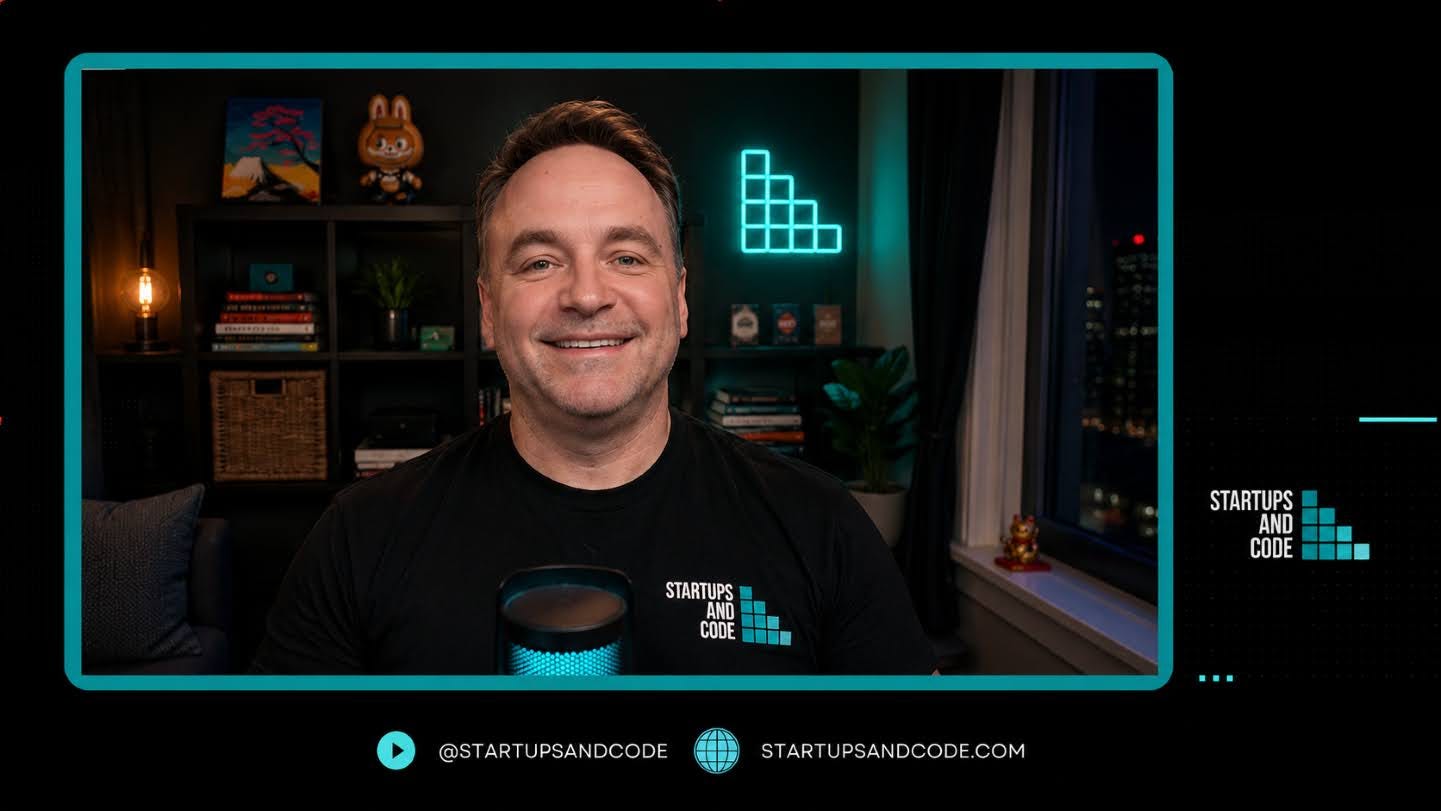
Real John here. Ok, as I mentioned previously, I’m going to write a little more this weekend, and sent out a survey yesterday, and today is a little advice that I took from myself. I’ve been helping everyone build things, improve their business, get more clients, and redo their website to be aligned with their actual business, not what they think their business is. This week I took my own advice and executed. Eight of clubs, if you know you know. (new deck by the way from The Art of Play in Brooklyn)
This week is a little different. No headlines, no acquisition breakdowns, no model comparisons. This week, I’m talking about something I built for myself.
I rebuilt startupsandcode.com.
Here’s the confession part. For someone who has spent 30+ years telling people to ship, I let my own site sit in “good enough” mode for way too long. The cobbler’s kids have no shoes, and apparently the engineering advisor has a website that undersold everything he actually does. I’d tell a client to fix that in the first fifteen minutes of a call. It took me considerably longer to take my own advice.
So I did what I always tell you to do. I sat down, defined the actual problem, broke it into small pieces, and executed.
What Startups and Code Actually Is
Let me be direct, because that’s the whole point of the rebuild.
Startups and Code is an engineering advisory practice. I help founders, CTOs, and engineering leaders make better technical decisions, build engineering organizations that consistently deliver, and apply AI where it creates real leverage instead of real chaos.
Notice what I didn’t say. I didn’t say AI consulting. I didn’t say digital transformation. I didn’t say tailored end-to-end solutions, because I’d rather delete my newsletter completely than write that sentence, no really.
Here’s the point of view the entire site is built on:
Most companies don’t have an AI problem. They have an execution problem. AI simply exposes it.
I’ve watched this play out over and over. A team adopts the latest tools, the demos look incredible, and six months later delivery is somehow slower. The tools were never the issue. The decision-making, the architecture, the team structure, the delivery habits, that’s where the leverage lives. AI just turns the volume up on whatever you already are. If your organization executes well, AI makes you faster. If it doesn’t, AI helps you ship bad decisions at unprecedented speed.
You don’t need another AI tool. You need a better engineering organization.
How I Work With Teams
I kept it simple. Three ways to engage:
Executive Engineering Review (starting at $5,000). For leaders facing a consequential decision: architecture, roadmap, hiring, team structure, AI adoption. You get a written assessment, clear priorities, risks, recommendations, and a 90-day action plan. Judgment on paper, not a workshop with sticky notes.
AI Engineering Sprint (starting at $15,000). Two to four weeks improving how a real team actually works. AI-assisted development, Claude Code rollout, agentic workflows, delivery friction. Measured by delivery improvement, not by how many tools got installed.
Fractional Engineering Advisor (starting at $7,500/month). Ongoing senior judgment without adding a full-time executive. Architecture review, roadmap input, hiring calls, team coaching, practical AI decisions.
The thing underneath all three is the same operating loop I’ve used for two decades of leading engineering teams. I call it the Engineering Flywheel: Clarify the right decisions, Strengthen the team and systems, Accelerate delivery without sacrificing quality, Compound that into a lasting advantage.
This isn’t theory I read in a book. It’s what I’ve done at Microsoft, at startups, as a CTO, and on my own products. When I tell you constraints breed better work, it’s because I built Cash Critters on a $50/month budget. When I tell you AI tools need engineering judgment wrapped around them, it’s because I use them every single day.
The Ask
I almost never do this, so when I do, it matters.
If you’re a founder or engineering leader at a startup with roughly 10 to 150 engineers, and you’re staring down a decision that actually matters, I want to talk to you. If you know someone in that seat, forward them this email. That’s genuinely the most valuable thing you can do for me this week.
The first step is a strategy call. No pitch deck, no discovery theater. You bring the problem, I bring 30 years of pattern matching, and we figure out if I can help. If I can’t, I’ll tell you that too, and probably point you somewhere useful anyway.
The site is live. It says exactly what I do and who I do it for, in plain language, with real prices. That alone puts it ahead of half the consulting sites on the internet.
I practiced what I preach. Defined the problem, shipped the solution, and now I’m telling you about it. That’s the whole playbook.
Now go build something amazing. And if you’re stuck on what to build next, you know where to find me.
John Mann is the founder of Startups and Code LLC, a software engineering executive, and the guy who built Cash Critters for $50/month because constraints are a feature, not a bug. Subscribe for weekly takes on AI, startups, and building things that matter.


